Unit 7A, 30-32 Barcoo Street, Roseville NSW 2069
Unit 7A, 30-32 Barcoo Street, Roseville NSW 2069

When grinding concrete, several important factors directly affect how your diamond grinding tools perform on the surface. Understanding these factors helps you save time, protect your tools, and reduce costs. These factors include the slab’s compressive strength, the size and hardness of the aggregate in the mix, the type of sand, and the concrete’s age.
One of the biggest influences is the concrete’s curing time. Curing determines how the concrete responds during grinding and depends on environmental and material conditions such as temperature, moisture levels, seasonality, and the use of admixtures or different sands and aggregates. For example, concrete poured in cold weather takes longer to cure, which affects when you can start grinding and which tool bonds will work best.
The age of the concrete strongly influences how your diamond tools behave. Freshly poured slabs undergo a curing process that bonds the materials and determines how the surface responds under grinding.
Green concrete—concrete that is 6 to 48 hours old—has not fully hardened. During this phase, the sand hasn’t fully bonded with the mortar, making the surface softer and more prone to tearing under aggressive grinding. As a result, you should use softer bond diamond tools to prevent excessive wear or clogging.
In contrast, cured concrete, typically older than 48 hours, reaches a hardness level where the sand firmly bonds with the mortar, and the compressive strength approaches its final rating. Grinding becomes more predictable, and you can fine-tune tool selection based on known variables like aggregate type and strength. Fully cured concrete varies widely in compressive strength, often measured in PSI (pounds per square inch), and this affects how diamond segments perform.
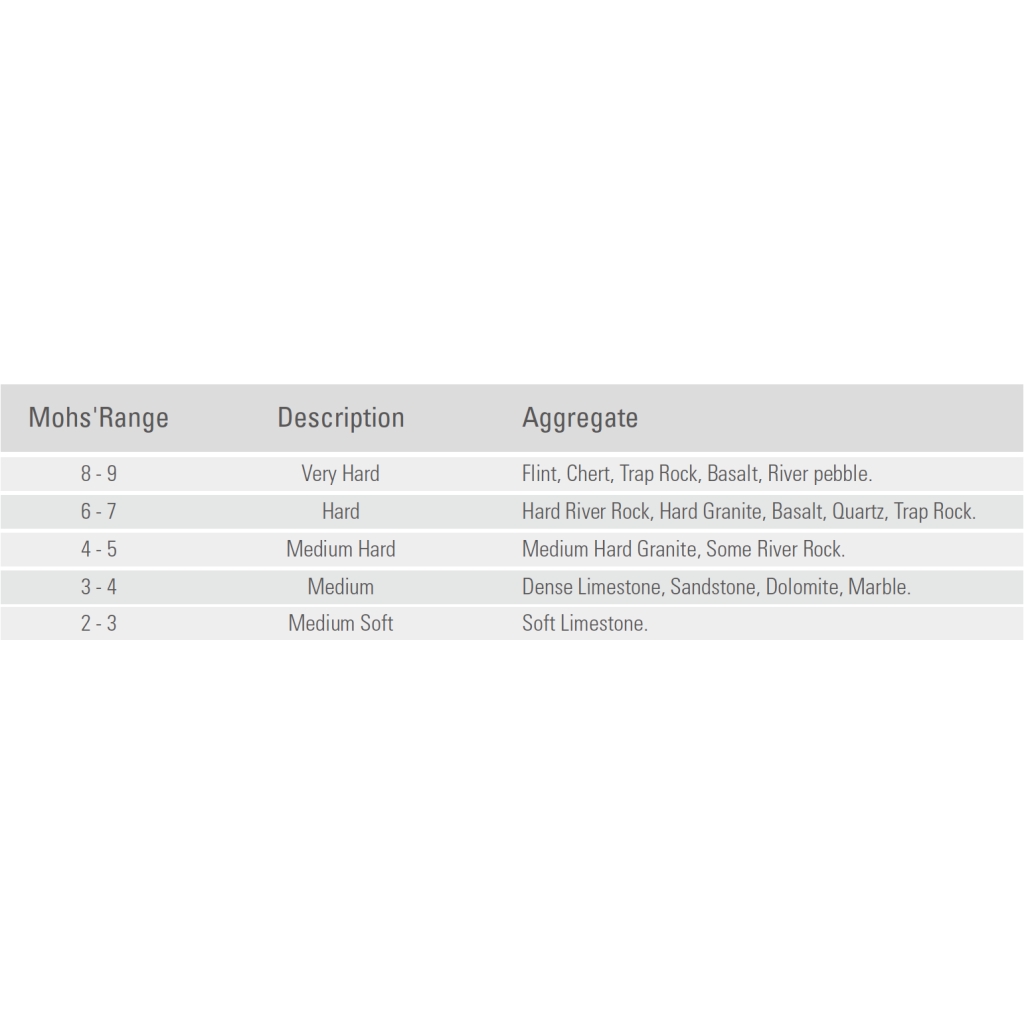
Aggregates make up 60–75% of a concrete mix’s volume. These granular fillers—such as gravel, crushed rock, or sand—give the concrete its mass. Aggregates vary in hardness, which we measure using the Mohs scale, ranking materials from 1 (talc) to 10 (diamond). Most aggregates fall between 2 and 9 on this scale.
The hardness of the aggregate determines the bond type you need for your diamond grinding shoes. For harder aggregates, choose a softer metal bond. This allows the segment to wear down steadily, exposing fresh, sharp diamond grit for efficient cutting.
For softer aggregates, use a harder bond. Because diamond grit wears more slowly on softer aggregate, a harder bond holds the diamonds in place longer, maximizing their cutting potential before they shed.
Even within a single rock type—like granite—you may find variations in hardness and friability. This inconsistency makes it important to field-test different bond levels on-site to achieve precise results.
A higher Mohs number means the material scratches substances with lower numbers. This scale helps you understand how various minerals rank by hardness.
Not all sands are created equal, and neither are their reactions to grinding tools. The type of sand, its moisture content, and how it’s been blended with admixtures can alter how abrasive the surface becomes. In particular, admixtures and weather conditions—like humidity or high temperatures—can significantly affect the curing time. Which in turn influences the choice of tools and grinding strategy.
If you’re unsure which tool to begin with, it’s usually a good idea to start with a medium bond. Depending on how the tool wears and how the surface responds, you can adjust to a softer or harder bond. Check out our range of grinding concrete tool here.